Services
Micro Tooling
What does it mean to have your toolmaker, your molder, and your metrology team in the same building?
It means a shorter, stronger development process.
And the result? A 90% first-shot rate.

In-house tooling is the foundation that supports every other service MTD provides. A tool capable of maintaining 0.0002" parting-line mismatch enables the validation team to achieve Cpk ≥ 1.33 on critical dimensions during process validation. And when cavity geometry can be verified by the metrology lab just steps away, potential deviations can be identified and corrected in hours instead of weeks.
At the micro scale, the proximity of the toolmaker, the molder, and the quality technician is the difference between a program that ships on schedule and one that stalls in revision.
Why micro tooling is different from conventional tooling
Conventional mold build is an exercise in bulk steel removal and surface finish. Micro tooling inverts both:
- Electrode size drives feature size. A conventional EDM shop works with 0.020"–0.040" electrodes. MTD's Sarix 3D EDM runs electrodes down to 5 microns (≈0.0002") at 0.1-micron positioning resolution. That is the physical capability behind every .004" wall and Ø.002" hole.
- Workpiece accuracy measured in millionths. MTD's toolroom holds workpiece accuracy to 42 millionths of an inch (≈1 micron). This is the threshold at which micro geometries become repeatable tool-to-tool and cavity-to-cavity.
- Parting-line mismatch has to be a tenth of a feature. A conventional parting-line target of 0.002" is meaningless on a part whose smallest feature is 0.004". MTD targets parting-line mismatch under 0.0002" and flash under 0.001".
- First-sample geometry has to be >95% of production intent. Micro tools cannot tolerate multi-round "iterate in steel" revision cycles. MTD targets >95% of final part geometry present at the first sample — the number that determines how fast a program moves from T0 to qualified production.
How a micro tool is designed
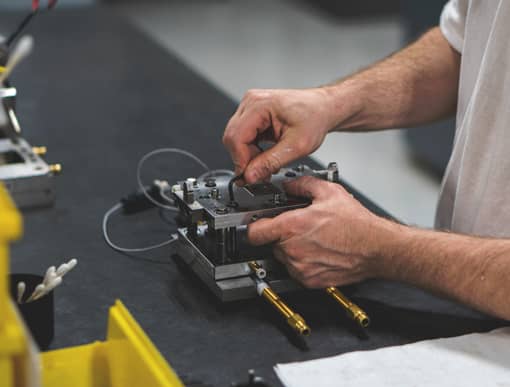
Once geometry, dimensions, and tolerances have been agreed with the customer through Design for Manufacturing, internal tool design begins.
Toolmakers, molders, and metrology engineers typically meet for a 60-minute design review.
- The toolroom verifies that every mold component can be produced and built robustly.
- The molding team confirms that the part can be ejected cleanly and that custom end-of-arm tooling will preserve orientation through to inspection.
- The metrology team confirms what fixturing will be needed to qualify the part once it is molded.
After the meeting, the tool designer completes the mold layout, and the same team reconvenes to review the final configuration before it is released to the shop floor for fabrication.

Tool ownership and lifecycle
The customer retains full ownership of the tool, while MTD provides ongoing maintenance, cavity-level traceability, and engineering support throughout the life of the program. Built from hardened steel and engineered for long-term production stability, MTD tooling is designed to remain in service for the duration of a program — with many tools continuing to run reliably year after year in active production.
Standard preventive maintenance and tool health reporting are included with all programs. For high-volume programs, MTD offers a program that includes proactive monitoring, spare component stocking, qualification activities, and all repairs.
What’s the difference between micro tooling and conventional injection-mold tooling?
Micro tooling operates at a completely different scale of precision. In conventional molding, tolerances are often forgiving relative to the part size. In micro molding, tool features may be measured in microns, and even minor variation can affect part performance, validation, and yield.
At MTD, micro tooling is developed as part of an integrated system that combines tooling, molding, metrology, and process development to achieve repeatable micro-scale performance.
What does “workpiece accuracy” mean, and why does it matter more than the equipment’s published specification?
Workpiece accuracy refers to the accuracy of the finished feature or component — not just the theoretical positioning accuracy of the machine tool.
In micro molding, machine specifications alone do not guarantee performance. Thermal growth, deflection, electrode wear, material behavior, and measurement uncertainty all affect the final result. MTD focuses on verified cavity geometry and validated molded-part performance, because that is what ultimately determines process capability.
Does MTD design and build its own molds, or outsource any part of tooling?
MTD designs and builds its tooling entirely in-house.
Keeping tooling, molding, metrology, and validation under one roof allows for faster development cycles, tighter process control, and immediate collaboration between engineers, toolmakers, and molders throughout a program’s lifecycle.
How does MTD handle tool wear and maintenance over the life of a production program?
MTD treats tooling as a long-term production asset. Hardened steel tooling is maintained throughout the life of the program using cavity-level tracking, in-house metrology, and preventative maintenance practices.
Because tooling and production teams work closely together, dimensional drift and wear can be identified early and addressed before process capability is affected.
Can MTD build tooling for high-wear materials like carbon-filled PEEK or filled-Pebax?
Yes. MTD has experience developing tooling and processes for highly abrasive, high-temperature engineered materials, including carbon-filled PEEK and filled Pebax.
These applications require specialized tooling strategies, hardened steels, thermal management, and tightly controlled processing conditions to maintain repeatability and tool life at the micro scale.
100% MICRO • 100% MEDICAL & HEALTHTECH • 100% IN-HOUSE

Micro Materials
Micro Part Design
Micro Tooling
Micro Molding
Micro Metrology